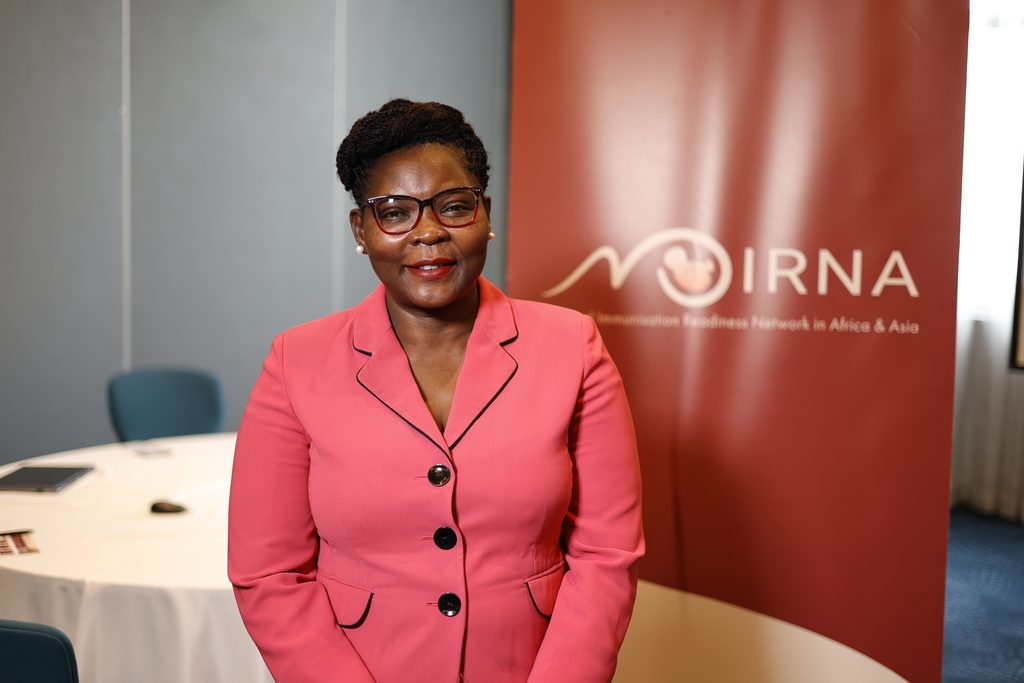
By morning, Professor Annettee Nakimuli may be teaching the next generation of doctors. By afternoon, she is on a labour ward in Kampala, managing some of the highest-risk pregnancies in East Africa. By night, her mind is often on a genome. Few people move between the delivery room and the genetics laboratory as comfortably as she does, and fewer still have changed what the world knows about a disease because of it.
She is Dean of Makerere University’s School of Medicine, the oldest medical school in East Africa, and President of the East, Central and Southern Africa College of Obstetrics and Gynaecology. Titles like these usually take a clinician away from the bedside. Hers have not. She still practises high-risk obstetrics at Mulago Specialised Women’s and Neonatal Hospital and Kawempe National Referral Hospital, where birth volumes rank among the highest in sub-Saharan Africa.
Then there is her PhD, mentored by Professor Ashley Moffett at the University of Cambridge, she led the first genetic case-control study of pre-eclampsia among indigenous Africans. The findings upended long-held assumptions about why the condition hits African women so hard. Clinician first, scientist always: that double life shapes everything she says about the disease she has spent her career fighting.
A killer hiding behind late presentation
“I have for over twenty years research been a clinician scientist and researched some of the common problems that affect pregnant women in Africa, where we have the highest burden of maternal death,” she said. “Over 70 per cent of maternal death globally happen in Africa.”
Within that broader crisis, one condition has held her attention above all others. “One of those I have been of very keen interest to address is pre-eclampsia, which generally is the number two, sometimes number one, killer of women in this setting.”
The tragedy, she explained, is compounded by timing. Women often reach care only once the disease has already progressed. “Part of the problem is that they present late to care. So, the late detection makes them get severe complications and sometimes death.”
Clinicians treating severe pre-eclampsia frequently have no choice but to deliver the baby early, whatever the risks of prematurity, in order to save the woman’s life. “We also end up having a lot of their babies either get stillborn or are born prematurely as we try to reverse the disease in the mother, again creating another burden of newborn death from prematurity complications.” A single disease, in other words, generates two overlapping tragedies.
Sorting risk, tailoring care
Faced with a health system that cannot give every pregnant woman the same intensity of monitoring, Professor Nakimuli has focused much of her research on identifying who needs it most. “Part of the work I’ve done was around trying to risk-profile women who are at risk of getting pre-eclampsia,” she said.
“The aim of that is to find which women would benefit from some of the interventions and others that will be discovered, because we know we can’t give every woman the same level of care due to limited resources. So, we need to know who is most at risk, so that we can start those interventions.”
Risk profiling, in her framing, is not merely an academic exercise. It changes what happens in the antenatal clinic and delivery room. “We also offer tailor-made care so that we are able to follow them up more closely in the antenatal clinic and during the time of childbirth, so that they are able to get better outcomes than they currently do if they are not detected early.”
Rewriting the genetics of an African disease
Where Professor Nakimuli’s work has attracted the most international attention is in genetics, a field long weighted towards populations of European descent. She sees that imbalance as a scientific opportunity as much as an injustice. “It’s worldly known that Africa has the biggest genetic diversity. We are the original gene pool, so there are many genetic variants that are yet to be actually discovered.”
Her own research has already begun filling that gap. “The work I did actually identified some very new, what they call novel, genes that are associated with pre-eclampsia, which have actually made the understanding of the disease better, and probably in future inform better intervention and better care.” For a condition that has, in her words, “for a long time been difficult to exactly know why some women get and others don’t,” that shift in understanding carries real weight.
The uncomfortable economics of maternal research
Ask Professor Nakimuli what holds the field back, and she does not hesitate. “Some of the biggest challenges in sustaining maternal health research in Africa in particular is financing. It’s very low on the priority list, funding list, because of other more pressing problems, probably.”
She is careful to note this is not a purely African problem. “This is not a uniquely African problem. We know generally maternal health is not as high priority for funding as things like heart disease, cancer, name it. But it’s much worse here.”
Compounding the shortfall is where the money comes from in the first place. “Most of the funding is not domestic funding. It’s from other international bodies, which may have other priorities.” The practical consequence, she argued, is that Africa’s own distinctive maternal health burdens get squeezed out. “What that has meant is that most of those problems that affect mothers and are uniquely African, such as pre-eclampsia, where it causes a lot of complications, they end up being not at the forefront of research.”
Even when research does happen, African women are frequently under-represented in the resulting evidence base, a gap Professor Nakimuli attributes largely to cost. “The infrastructure is not as fully supportive as it should be. It’s much more expensive to do research in Africa than elsewhere, because we don’t have regional suppliers of laboratory supplies, equipment.”
Turning evidence into practice
For all these obstacles, Professor Nakimuli is precise about how she ensures her findings do not simply sit in journals. It begins, she said, with who is in the room when a study is designed. “I try as much as possible to involve the communities that are most affected, the pregnant women in this case and their families, in designing these studies. We’ve seen that that is usually very helpful. They bring out insights which would not be envisaged if we didn’t, even including how to consent them to participate.”
From there, the circle widens deliberately to include policymakers, clinicians and social scientists alike, each bringing something the others cannot. “It’s a whole chain of involving different stakeholders, starting from designing all the way to the dissemination of findings,” she said. “We try to publish, writing policy briefs, and also trying to make linkages with industry.”
It is a model built on a conviction she has carried since the earliest days of her career: that understanding a disease genetically means little unless that understanding eventually reaches the woman in labour, hundreds of miles from any laboratory, whose life depends on being recognised as at risk before it is too late.
Leave a Reply